
The Fruit and the Shit
AI won't kill most industries. It will strip them down to the part that was always the point.
Not long ago I heard Ben Thompson talking about music and light manufacturing. The story went something like this.
Nobody got into the music business because they wanted to work in specialized light manufacturing. But for decades, the entire industry, its revenue, its power structure, its economics, was organized around pressing plastic discs and shipping them in trucks. The music was always the point. The plastic was never the point. The plastic was where the money was, though, and the plastic was the moat. In most cases, music was not what protected the business. Light manufacturing was.
When the internet made distribution free, the industry almost collapsed. Not because the music died. The music was fine. The industry collapsed because the business had been built around the wrong layer, and a lot of talented people lost careers while the industry figured out what came next. The revenue model, the cost structure, the competitive advantages, all of it was attached to the plastic, not to the songs. And when the plastic became irrelevant, all of that went with it.
Then streaming asked a different question. Not “how do you replace the $15 CD?” but “what if you could have all the music that exists for $15 a month?” Revenue came back, and then some. The industry hit $29.6 billion in 2024, surpassing the CD-era peak, on a completely different model. More artists reaching more listeners than at any point in history. The music, the actual fruit, didn’t shrink when the plastic disappeared. It expanded. The music was the fruit. The plastic was the shit around it. And the shit was the only thing that died.
I think this pattern is going to play out again, across more industries than people expect, because of AI. And most of the conversation about AI and jobs is asking the wrong question.
The pattern
Not every business has this structure. Some are core all the way through. A Michelin-star restaurant, for instance: the moat is the chef, the experience, the food itself. There’s no incidental layer to peel off. The product and the infrastructure are the same thing. Those businesses are fine.
But some industries have a split that people inside them can’t see. There’s a core, the thing the customer is actually paying for, wrapped in a layer of shit that was never the point but ended up being the moat. The shit survived because it was expensive, not because it was valuable.
A platform shift doesn’t attack the core. It drives the marginal cost of the shit layer toward zero. When that happens, the moat dissolves. And if there’s real fruit inside, the fruit doesn’t shrink. It expands into territory it could never reach before, because the cost of the shit around it was the only thing holding it back.
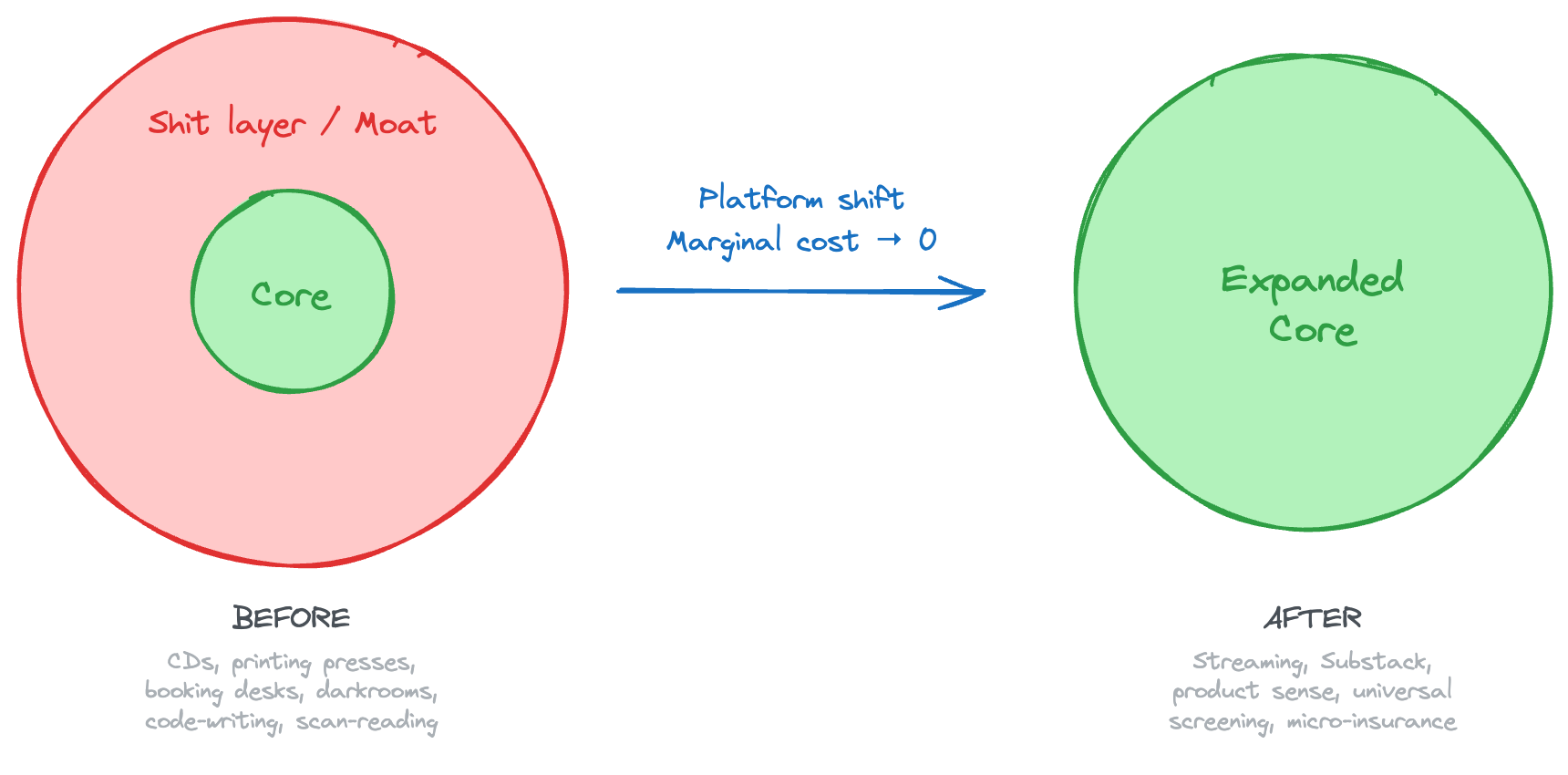
The internet drove the cost of distribution to zero. AI is driving the cost of human intelligence, applied at scale, to zero. Same dynamic, different layer.
Photography. The core was always the eye, the moment, the story you chose to tell. The shit around it was enormous: darkroom chemistry, film stock at a dollar per shot, processing labs, printing, the entire technical apparatus that made photography a professional’s medium. You needed years of training and thousands of dollars in equipment before you could even start learning to see.
Digital zeroed all of that. The cost per photo went from a dollar to effectively nothing. And instead of killing photography, it created an explosion that would have been unimaginable in the film era. We went from millions of photos per year to billions per day. Professional photographers didn’t disappear. The ones who survived are more in demand than ever, because the only thing left to pay for is taste. The shit is gone. The fruit is all that remains.
And then the fruit did something the efficiency framing completely misses. It didn’t just expand. It mutated. Instagram, visual journalism as a daily practice, content creation as a career, the entire influencer economy, an $800 billion creator market that exists because taking a photo became free and infinite. None of that was a more efficient version of what came before. It was new territory that couldn’t have existed when each photo cost a dollar to produce. The fruit didn’t just grow. It spawned an ecosystem that made the original industry look like a rounding error.
What AI zeros
The internet zeroed distribution. AI is zeroing intelligence. Specifically, the kind of routine, repeated, human intelligence that many industries depend on at scale. Then, maybe, the rest.
I wrote about this dynamic in Differentiation, Then Commoditization: once a task crosses the reliability threshold, competition shifts from capability to cost, and the economics change completely.
Software engineering is the case I know best, because I live inside it. The core of building a software company is knowing what to build. Product sense, user understanding, the search for something people actually want. The shit around it, for decades, was writing the code, debugging it, testing it, deploying it. Expensive, slow, requiring teams of people for anything non-trivial.
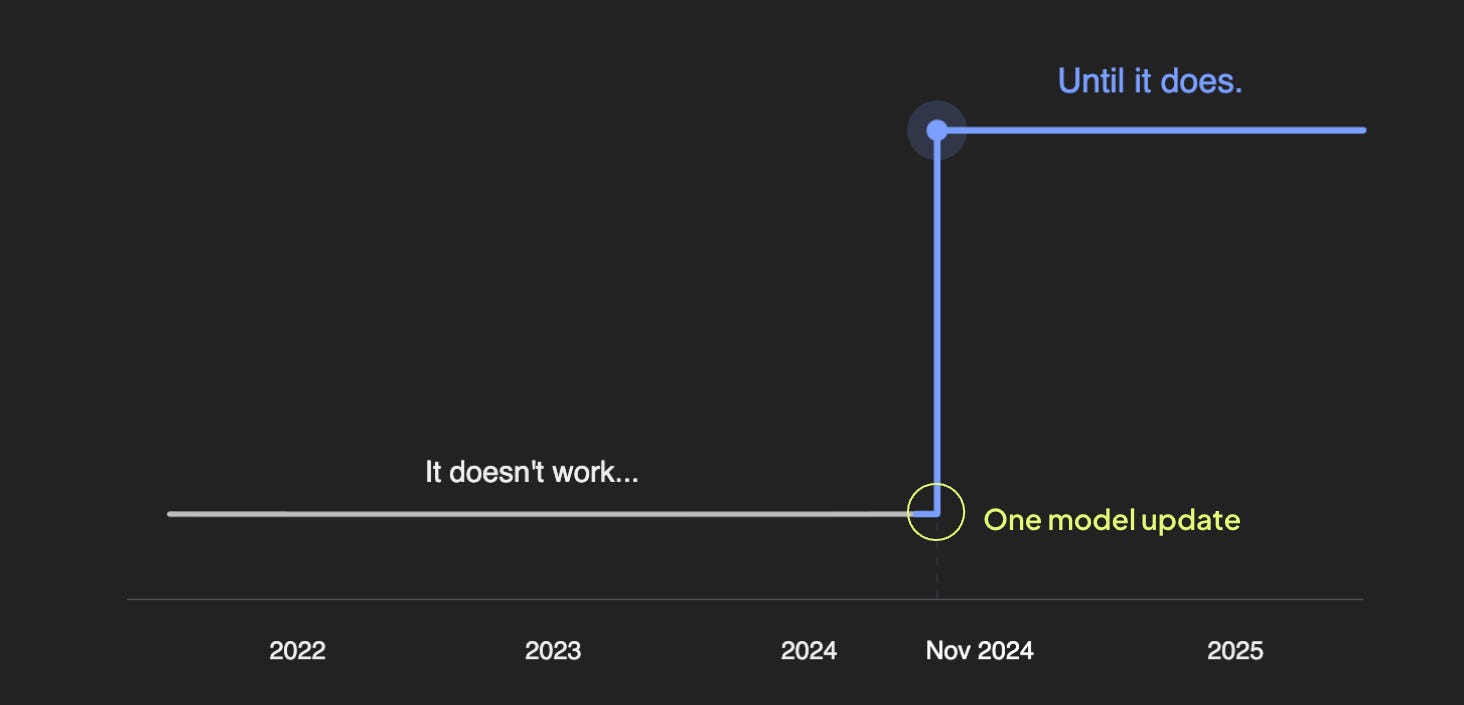
That cost is approaching zero. One person can now produce what took a five-person team eighteen months ago. The result isn’t fewer engineers. It’s more software. Ideas that were too expensive to try are getting tried. Internal tools that no company would ever have staffed for get built on a weekend. The cost of building a first version has collapsed, even as the cost of distributing and scaling that product hasn’t, which is why funding rounds keep getting bigger while MVPs get cheaper. The money didn’t disappear. It moved from engineering to growth, from the shit layer to the fight for distribution.
The fruit is expanding visibly. The shit is disappearing. Same pattern as music, same pattern as photography.
Netflix is the one company I can think of that recognized this pattern from the inside and acted on it. They were a DVD-by-mail business. The shit layer was physical distribution: warehouses, envelopes, postal logistics. They saw that their own shit was going to zero, killed the DVD business before anyone forced them to, and rebuilt around streaming. The core (helping people find and watch stuff they love) went from a few million DVD subscribers to 260 million streaming subscribers globally. They burned their own plastic.
Finding the split
I think software is just the first AI-era industry where the pattern is obvious, because we’re living through it and the evidence is right in front of us. The question that interests me is how many other industries have the same structure and haven’t noticed it yet.
For any industry, there are a few questions worth asking. What does the customer actually value, and what is incidental infrastructure that exists only because it used to be expensive? If you could rebuild this industry from scratch today, with AI capable of handling routine cognitive work at near-zero marginal cost, what would you keep and what would you throw away? If the shit layer disappeared tomorrow, would the core expand into new territory (like music into streaming, like photography into the creator economy), or would there be nothing left? And the hardest question: is AI already making your shit layer cheaper, and are you treating that as an efficiency gain rather than a structural shift?
The pattern I described in The Gap of Imagination applies here too: most people inside an industry can’t picture what it looks like without the shit, because the shit is all they’ve ever known. The darkroom technician couldn’t picture Instagram. The record label exec couldn’t picture Spotify. The inability to imagine the post-shift world is what makes the shift feel like destruction rather than expansion.
Who captures the value
The pattern tells you what happens to the core. It does not tell you who profits.
When music went to streaming, it was Spotify and Apple who captured the upside, not the artists and not the old labels. When photography went digital, it was Instagram and Apple (the iPhone camera) who won, not Kodak and not the photographers. Whoever builds the new layer between the liberated fruit and the people who want it captures disproportionate value. Not the people who grew the fruit. Not the people who used to run the shit layer. The ones who build what comes after. I wrote about this in E-commerce After The Prompt, and the dynamic is the same across industries: in a world where agents handle discovery and transactions, the layer between supply and demand is where the value concentrates.
Netflix is interesting because they’re one of the few who managed to do it to themselves. They recognized their own shit layer, destroyed it, and built the replacement. Most incumbents don’t have that instinct. Most incumbents add more shit on top (their own chatbot, their own AI wrapper, their own “AI-powered” version of the same bad product) and hope the moat holds.
For AI, that replacement layer barely exists yet in most industries. The fruit is being liberated, industry by industry, as the cost of intelligence drops and things cross the reliability threshold. But the infrastructure that connects the expanded supply to the people who need it is still missing. The accounting firm’s clients don’t have an agent managing their books. The uninsured farmer doesn’t have a micro-policy. The small business that could never afford a lawyer still doesn’t have access to legal judgment.
The fruit has always been there. The shit was the only thing keeping it small.
I agree with the core point, but I think there’s another layer of “shit” we still haven’t dealt with: prestige.
Even in examples like Michelin-star restaurants, it’s not clear that the “core” is purely the food. If you removed the star, the narrative, and the social signaling, would the experience hold the same value? I don’t think it would, even though the product itself hasn’t changed, only the perception.
As a result, the market often ends up rewarding things that aren’t actually additive. People optimize for prestige instead of what I’d call real utility, a product that’s genuinely better or cheaper.
In that sense, the product was always the same. The prestige layer, "the shit", is just what allowed it to stay overpriced.