
AI Is the Org
An honest look into a crazy sounding idea
Jack Dorsey said the crazy thing. AI is the org, people are there to serve it. My first reaction was cynical. This is an elegant way to justify cutting Block by 40%. Then I spent last week with Vinod and a few other people who think hard for a living, and the idea kept showing up. Where there is smoke, there is a fire. What are they talking about? How much is real?
What a company is
Let’s put on the MBA hat for a sec. My favourite place to start is Ronald Coase, 1937. Why do companies exist? In a free market, every task could in theory be a contract between strangers. The answer Coase came up with, and won a Nobel for decades later, is that markets are not free. Every transaction has a cost. Finding someone, negotiating, writing the contract, monitoring it, enforcing it. A company exists because, up to a point, doing the work inside is cheaper than doing it through the market. The size of the firm is set by where those two cost curves cross.
That definition treats the company as a black box. Inputs go in (capital, signal, time). Profit comes out. The org is the function. The people inside are an implementation detail that has been remarkably stable for two thousand years.
Why the box was full of people
For most of history, the box was full of people for one reason that has nothing to do with hierarchy, politics or the reason of the company to exist. Companies needed decisions to transform the inputs into benefits. Decisions need intelligence, and until very recently, the only place we knew how to source intelligence was inside a human brain. So humans were inside the box, both deciding and acting. The hierarchies that grew around them (Dorsey and Botha trace the lineage from the Roman contubernium through the Prussian general staff to the American railroads) were the cheapest known way to coordinate brains across distance and time. What is different now is not that this work was unnecessary. People were the only substrate that could do it. What changes is that a second substrate exists, and the interesting question is what happens when the two combine.
What is changing
Some decisions can now be made by an agent, often well, sometimes badly. Some actions can now be taken by an agent, often well, sometimes badly. The “often well” side grows every model release.
That changes the question we have to ask. It is no longer “do humans need to be inside the box at all.” It is “which decisions and which actions are now better to do with AI than with people.” Every company will have to answer that item by item, for years. Dorsey’s bet, the smoke that started this post, is that eventually the answer for almost everything is AI. Maybe he is right. Maybe he is overcorrecting because he just cut his company by 40% and needs the story to land. I do not know. What I do know is that the question itself is real, and the answer for any specific decision or action is rarely “none.”
Maybe an inversion
If most decisions and most actions inside the box move to AI, the position of the human inside changes. We used to be the operator. Spreadsheets, computers, every tool we built were extensions of us. We picked them up and put them down. Now, maybe, it is the opposite. The AI is becoming the operator, and the people inside the box are increasingly what it reaches for when it needs to do something it cannot do itself. The spreadsheet did not put accountants out of work. It moved them up one level. AI may be doing the same thing to us, one more level up.
What is still lacking
For the Dorsey version to actually arrive, four things have to become true that today are not.
First, the part of human work that is not strictly about intelligence: customer trust, ethical intuition in situations that are genuinely novel, the kind of judgment that only forms after years of skin in a game. Some of that is real signal an AI cannot generate on its own. Some of it is noise the org is better off losing (politics, taste-as-bias, the loudest voice in the room winning the argument), and a more AI-shaped org is honestly an improvement on the noise side. Both halves are true.
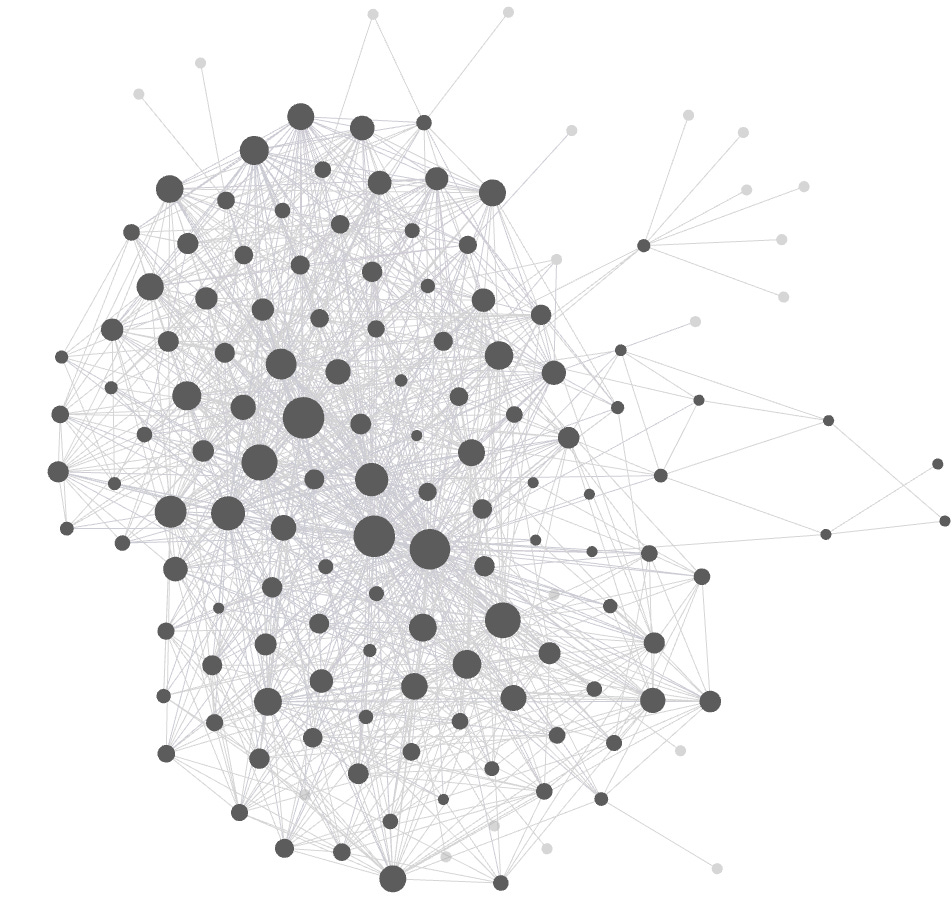
Second, and this is the bucket that matters most. Even a smart model only makes good decisions when it has the same context a human in the same role would have. Humans pick that context up everywhere: meetings, side conversations, Slack threads, customer calls, watercooler conversations, social cues, the unspoken stuff that lives in someone’s head from five years of doing the job. The model has none of it by default. So our new job, the part of human work that does not go away even when the intelligence is automated, is to gather context from across the company and make it legible to the machine. This is the part Dorsey makes look easy because Cash App and Square hand him a continuously updated picture of his customers for free. Most companies do not have that. They have a CRM, a few dashboards, and if lucky a wiki nobody updates. Building the layer that turns the messy reality of an organization into context the model can act on is the actual unsolved problem. It is the reason we created the org brain @luzia. Anyone who has tried to wire a model into a real business knows the model is the easy part now. Context is the hard part.
Third, agency under accountability. AI does not go to jail, and it does not lose a relationship the way a name on a contract does. Somebody human still has to be on the hook when something consequential breaks, and that gates how much agency an AI can have, regardless of how capable the model is.
Fourth, the objective. If you take the people out of the middle of the org, somebody has to write down what the org is optimizing for. The honest answer is the board. Boards already set the objective for human CEOs. In an AI-shaped org they would set it more directly, with fewer layers of interpretation in between. That is a clarification of where governance lives, not a limitation.
None of these are dealbreakers, and all of them are real.
There is a fire
Dorsey is probably more right than he was a year ago, and probably less right than he claims today. The honest way to read his essay is as a question. What does a company actually look like once intelligence stops being gated by a human brain? That exercise is, if you let it be, an optimistic one. Most companies get to rethink their fundamentals once in a generation, and this is one of those times. Done carefully, it produces two lists, one of decisions and actions to start handing to the machine, and one of places where the human role should grow. The companies that prepare will build both. The companies that do not will end up with one or the other. The smoke was Dorsey’s essay. The fire is the new shape of the company, and what is in that shape is a choice.